Can robots sew yet? Factories are automating everything except the seam
Robots now cut, move and inspect garments, yet the seam stays manual. US apparel jobs fell to 71,400 in September 2026 despite tariffs, while Bangladesh lines run with 30.58% fewer workers.

KEY TAKEAWAYS Summary by the editors
- US apparel manufacturing employed 71,400 people in September 2026, down from 81,800 in January 2025, despite tariffs meant to encourage reshoring.
- A BRAC University study found automation cut the workforce per production line in Bangladeshi garment factories by 30.58%, with cutting down 48.34% and sewing down 26.57%.
- Softwear Automation raised USD 20 million led by Bestseller in August 2025, but its Sewbot worklines were still described as approaching commercialisation.
- Asia-Pacific counted about 65 million garment jobs in 2023, 55% held by women, so the real change is in cutting, handling and inspection rather than in sewing itself.
In September 2026 the United States employed 71,400 people in apparel manufacturing, according to Bureau of Labor Statistics data. That is fewer than the 81,800 counted in January 2025, before a year of tariff escalation that was supposed to make domestic production attractive again, and less than a tenth of the 938,600 recorded in January 1990. Tariffs have made imported clothing dearer. They have not brought the sewing floor home.
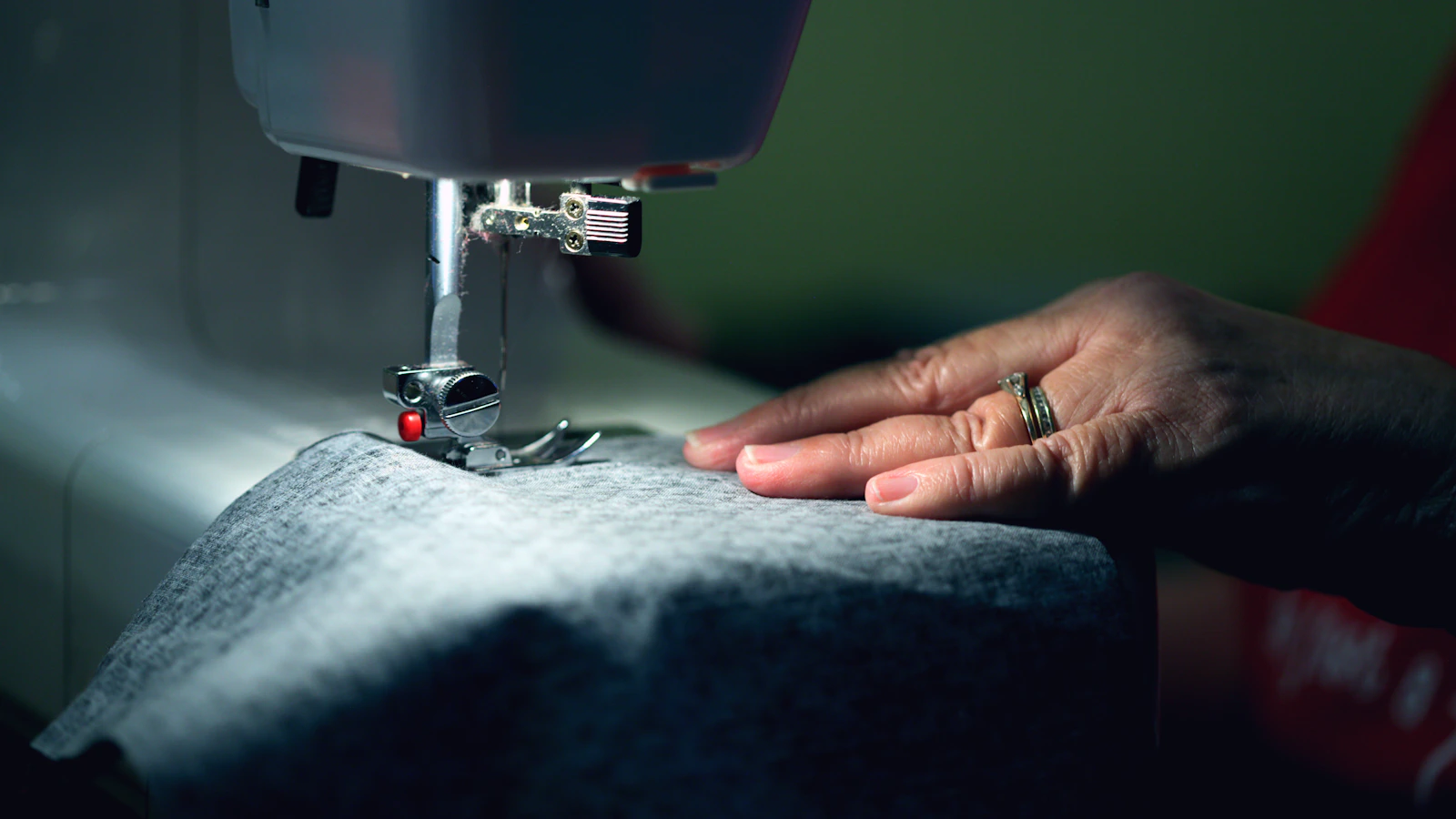
The reason lies on the factory floor itself. Machines and software now cut fabric, carry garments between work stations, monitor every sewing machine and flag defects in Bangladesh and Vietnam. But the central act of garment making, guiding two pieces of limp, stretching fabric under a needle, is still overwhelmingly done by hand. The short answer to the headline is that robots can sew in pilots and narrow niches, not a mainstream wardrobe at scale. The automation that is spreading fast is the work around the seam.
People employed in US apparel manufacturing in September 2026, down from 81,800 in January 2025 and 938,600 in January 1990
Tariffs have raised import costs, but domestic garment employment has kept falling rather than rebounding.
Source: US Bureau of Labor Statistics via FRED, 2026
That distinction matters now because it decides who loses work and where clothing gets made. The ILO and IFC Better Work programme counted about 65 million garment jobs in Asia and the Pacific in 2023, just over 4% of regional employment, and about 55% of them were held by women. In Bangladesh, a 2024 study found automation had cut the workforce per production line by 30.58%. For brands promising reshoring and suppliers under tariff pressure, knowing which tasks machines can really take over is a sourcing question, not a technology curiosity.
How far has sewing automation really come by 2026?
The best-known attempt to automate the seam is the Sewbot from Softwear Automation, an Atlanta company. In August 2025 it closed a USD 20 million Series B1 round led by Bestseller, the Danish owner of Jack & Jones, Vero Moda and Only, through its Invest FWD platform; Bestseller's chief financial officer, Thomas Børglum Jensen, joined the board. Chairman and chief executive Palaniswamy "Raj" Rajan called the deal "a powerful catalyst for the future of on-demand, localized, and more sustainable apparel manufacturing". Yet Textile World's report of the round described the fully automated Sewbot worklines as approaching commercialisation, and named no customer beyond the investor.
The history explains the caution. The Business of Fashion reported that Softwear had agreed in 2017 with the Chinese manufacturer Tianyuan Garments to build a robotic T-shirt line for a factory in Arkansas planned for 2018. When BoF revisited the project, the factory was still not operational, its location undecided, and the company had stopped working with Li & Fung. "We anticipated two years and it's taken us five," Rajan told the publication, adding that the company "ran into technology challenges working with knitted fabrics". The Seattle start-up Sewbo claimed the first robotically sewn garment, also a T-shirt, back in 2016; a decade later, robotic sewing of everyday garments has still not become an industry standard.
Footwear offers a cautionary precedent. Adidas ran a robotic Speedfactory in Ansbach, Germany, built with Oechsler, a maker of automotive and industrial parts, plus a second one in the US. It closed both in 2019 and moved the technology to Asian suppliers. Its best sellers, such as the Stan Smith and Superstar, still required stitching the robots could not do. In 2017 the then chief executive Kasper Rorsted put it bluntly: "The biggest challenge the shoe industry has is how do you create a robot that puts the lace into the shoe," he said. "There is no technology for that."
Why is sewing so hard to automate?
Metal and plastic parts hold their shape; fabric does not. It bends, stretches and shifts as it is fed, so an operator makes continuous small corrections that are trivial for human hands and very hard for a machine. Knitted fabrics, which give T-shirts and sportswear their stretch, are harder than woven ones, and materials vary widely even within a simple product. Rajan summed up the T-shirt as "a simple garment but a complex fabric". Every new fabric, size or style multiplies the cases a robot must handle, which is exactly the variety fashion depends on.
That is why the more successful robotics companies start with narrow, repetitive textile tasks. The Munich start-up sewts raised a EUR 7 million Series A led by Emerald Technology Ventures for its Velum cell, launched in 2022, which picks crumpled towels out of a pile and feeds them into folding machines for industrial laundries at roughly human speed. The Otto Group helped build a prototype for handling returned e-commerce clothing. Co-founder and chief executive Alexander Bley calls the long-term aim of revolutionising textile production a "moonshot". The sequencing is telling: towels and returns first, garment assembly much later.
| Commercial maturity | Documented labour reduction | |
|---|---|---|
| Fabric cutting | high | high |
| Garment transport (hanger systems) | high | medium |
| Machine monitoring and line balancing | medium | low |
| AI visual quality inspection | low | none |
| Sewing of woven garments | low | medium |
| Fully robotic sewing of knits | none | none |
0 = pilot or claim only; 3 = widely deployed with documented effects
Source: Editorial assessment based on BRAC University study (TBS, 2024), TBS 2024, BoF and Viet Nam News 2026
What are factories in Bangladesh and Vietnam actually automating?
On the ground, automation looks less like a sewing robot and more like conveyors, sensors and software. The Business Standard documented several Bangladeshi cases in 2024. Pacific Jeans adopted an intelligent overhead hanger system that moves garments between production steps automatically; the supplier reported 20% less labour and 20 to 35% higher productivity. Team Group fitted IoT devices into sewing machines under a system called Nidle and reported output up to 12% higher. Fatullah Apparels spent USD 80,000 on production monitoring devices for 250 machines, expecting payback within three years, and its chief executive said the data would help "reduce unfair practices on the production floor by the supervisors". DBL Group invested in remote oversight, predictive maintenance and automated quality checks without publishing results.
Vietnam, the world's second-largest garment exporter with USD 46 billion of textile and garment exports in 2025, is following the same pattern. At an industry forum in May 2026, the automation supplier INA said its hanging conveyors and robotic warehouses had raised productivity by 25 to 35% for the sportswear group Anta, 20 to 30% for lingerie makers and 6 to 20% for other sportswear producers. A spinning mill with 50,000 spindles was cited as having cut its staff from 200 to 300 workers to 30 to 40. Vu Duc Giang, chairman of the Vietnam Textile and Apparel Association, described technology, automation, robotics and AI as "the only viable path forward", and said such equipment had become far more affordable than three years earlier.
The less visible gains come from software that sits upstream of the sewing line. Fatullah Apparels also spent USD 10,000 on computer-aided design software and expected it to pay back within a year, mainly by cutting fabric waste through better marker planning. Envoy Textile installed online monitoring for indigo dyeing and planned to spend about USD 1 million more on automating its spinning units, with its chairman, Kutubuddin Ahmed, saying "robotic technology ensures higher productivity and superior yarn quality". The common thread is data: once every machine reports its output in real time, supervisors can rebalance operators towards bottlenecks during the shift instead of discovering them at the end of the day, which is what most suppliers mean when they describe AI line balancing.
Computer vision is the newest layer. In May 2026 Ecotextile News reported that ThreadBridge, a Bangladeshi start-up, had deployed AI-enabled smart glasses that let inspectors detect fabric and sewing defects in real time in four garment factories. No detection rates were published, which is typical: most quality-inspection claims in the sector are vendor statements rather than audited results.
| Company | Technology | Reported result | Status of evidence |
|---|---|---|---|
| Pacific Jeans (Bangladesh) | Automated overhead hanger system | 20% less labour, 20 to 35% higher productivity | Supplier claim, 2024 |
| Team Group (Bangladesh) | IoT sensors in sewing machines | Output up to 12% higher | Company claim, 2024 |
| Fatullah Apparels (Bangladesh) | Monitoring devices on 250 machines | Payback expected within three years | Company expectation, 2024 |
| Anta (via INA, Vietnam) | Hanging conveyors, robotic warehouse | Productivity up 25 to 35% | Supplier claim, 2026 |
| ThreadBridge (Bangladesh) | AI smart glasses for defect detection | Deployed in four factories, no accuracy data | Media report, 2026 |
| Softwear Automation (US) | Autonomous Sewbot worklines | USD 20 million raised, approaching commercialisation | Company statement, 2025 |
What does automation mean for garment jobs?
The most detailed recent evidence comes from Bangladesh. Researchers at BRAC University, supported by Solidaridad Network Asia and the Bangladesh Labour Foundation, surveyed 429 workers in Dhaka, Gazipur and Narayanganj between August and October 2024, alongside 26 stakeholder interviews and four focus groups. They found the workforce per production line had fallen by 30.58% due to automation, by 37.03% in sweater factories and 27.23% in woven factories. Helpers, who do low-skill tasks such as feeding and trimming, were the most affected, along with women, older workers and those with low literacy.
The split by process is the clearest proof of where machines bite. Cutting, where automated spreaders and cutters are mature, lost 48.34% of its workers. Sewing lost 26.57%, largely through supporting tasks rather than robotic stitching.
Source: BRAC University, Solidaridad, BLF study via The Business Standard, 2024
A separate study by the Bangladesh Institute of Development Studies, presented in December 2024, estimated that between 2.15 and 4.13 workers lost their jobs for every USD 1 million spent on new equipment, and that the female share of the garment workforce slipped from 56% in 2014 to 53% in 2023. In the sector's early years, women made up more than 80%. Industry representatives argue the picture is mixed. Miran Ali of the Bangladesh Garment Manufacturers and Exporters Association said: "The industry will not fully embrace automation, but there is potential to adopt partial automation." The labour ministry's secretary, AHM Shafiquzzaman, was blunter about the alternative: "If we don't embrace it, their country will suffer. The RMG sector will suffer."
Will automation bring garment production back to Europe and the US?
The data so far say no. Beyond the falling US employment figures, the 2026 Fashion Industry Benchmarking Study by the University of Delaware and the US Fashion Industry Association, which surveyed 30 leading US fashion companies from April to June 2026, found that 56% sourced some apparel from the United States, up from 40% in 2025. But US-made products accounted for less than 10% of their sourcing volume or value, and only 10% named increased "Made in USA" sourcing as a strategy for coping with tariffs. Sourcing from CAFTA-DR countries in Central America rose to 76% of respondents, from 64%. Nearshoring, in other words, is moving work to lower-cost neighbours, not to robots at home.
Tariffs have also squeezed the budgets that would fund automation. In the same study, 85% of companies said tariff increases had hurt their financial performance, up from 78% a year earlier, 74% reported higher sourcing costs, and more than half said tariffs had reduced the resources available for sustainability and product innovation. Some 92% ranked protectionist policy and tariff uncertainty among their top two challenges for 2026. An industry that cannot predict its duty rates from one quarter to the next is poorly placed to commit capital to robotic factories whose payback depends on years of stable volumes in a high-wage country.
Even established automation is cyclical. Shima Seiki, the Japanese maker of WholeGarment knitting machines that produce entire sweaters with no sewing at all, reported revenue of JPY 32.5 billion for its 2025 financial year, down 9.4%, and a net loss of JPY 14.3 billion. Seamless knitting is the closest the industry has come to removing the seam altogether, yet it remains a capital good whose sales track the investment appetite of Asian knitwear suppliers, not a reshoring engine. Softwear and Bestseller pitch Sewbot as a way to produce "closer to the consumer" with less waste; until worklines run commercially at scale, that remains a company claim.
What are the risks and limits of the automation story?
The first limit is evidence. Almost every productivity number in this article comes from a supplier or a manufacturer describing its own investment, measured on its own baseline and rarely net of capital, maintenance and downtime costs. The academic studies from Bangladesh are more rigorous but rest on worker surveys rather than full payroll data, and they cannot cleanly separate automation from order losses or energy shortages. Miran Ali pointed out that worker efficiency in Bangladesh is held back by power cuts, port congestion and road traffic, problems no robot solves.
The second is that forecasts have repeatedly overshot. A 2016 ILO projection, widely reported at the time, put nearly 90% of Cambodia's garment factory jobs at risk of automation within roughly two decades. Ten years on, Asia and the Pacific still count about 65 million garment jobs, and the ILO reports that the female share across the region rose to about 55% in 2023 from around 51% in 2002. Displacement is real, but it is concentrated in specific tasks and specific groups rather than sweeping whole industries away.
The third is social and reputational. If automation removes helper and cutting jobs first, it removes the entry points through which young women and low-literacy workers join the industry. Brands that publicise automated suppliers without asking what happened to those workers expose themselves to due diligence questions under supply-chain laws and their own human rights commitments.
What should fashion companies do now?
- Map automation by process step Ask key suppliers which tasks in cutting, handling, sewing and inspection are automated, and record headcount per line before and after.
- Treat vendor claims as hypotheses Request baseline data, measurement periods and cost of ownership before using supplier productivity figures in costing or sourcing decisions.
- Price automation into sourcing Factor monitoring, quality data and shorter lead times into supplier scorecards, not only unit price, so investment is rewarded.
- Design for automatable construction Where volumes allow, simplify seams and favour constructions such as seamless knitting that reduce manual operations.
- Test reshoring claims against data Base nearshoring plans on landed cost and capacity in regions such as Central America rather than on promises of robotic factories at home.
- Fund transition for displaced workers Support retraining for helpers and cutting staff, particularly women, and include automation impacts in human rights due diligence.
Frequently asked questions
Can robots sew clothes yet?
Only in narrow cases. Softwear Automation's Sewbot worklines were described as approaching commercialisation when the company raised USD 20 million in August 2025, and its chief executive has said knitted fabrics caused major technical problems. Mainstream garments are still sewn by people, while robots and AI handle cutting, transport and inspection.
How many garment jobs has automation replaced in Bangladesh?
A study by BRAC University with Solidaridad and the Bangladesh Labour Foundation, conducted in 2024, found the workforce per production line had fallen by 30.58% due to automation. Cutting fell 48.34% and sewing 26.57%. Helpers, women, older and lower-literacy workers were hit hardest.
Is clothing manufacturing returning to the United States?
Not in employment terms. The Bureau of Labor Statistics counted 71,400 apparel manufacturing jobs in September 2026, down from 81,800 in January 2025. In the 2026 USFIA study, 56% of companies sourced some apparel from the US, but US-made goods were less than 10% of their volume.
How is AI used in garment factories?
The most common uses are production monitoring and line balancing through sensors on sewing machines, automated garment transport, and computer vision for defect detection. Bangladeshi factories report gains such as up to 12% more output from IoT monitoring, but most results are company claims rather than independent audits.
Sources
- FRED, Federal Reserve Bank of St. Louis: All Employees, Apparel Manufacturing (BLS)
- The Business Standard: RMG automation leads to 30.58% decline in workforce: study
- The Daily Star: Female workforce in garment industry slips to 53%
- ILO / IFC Better Work: Advancing decent work in garment supply chains in Asia and the Pacific
- Textile World: Softwear Automation secures USD 20 million in Series B1 funding round led by Bestseller
- FashionUnited: Bestseller leads 20 million dollar Softwear Automation funding round
- The Business of Fashion: Why robots still can't do one of fashion's most important jobs
- The Business Standard: Industries turn to robotics, new tech to boost productivity
- Viet Nam News: Digitalisation drives Viet Nam's apparel industry toward new growth period
- Ecotextile News: Bangladeshi startup introduces AI glasses to detect garment defects
- The Robot Report: sewts brings in USD 7.6M to automate the textile industry
- Textalks: US apparel tariffs raise costs but deliver little reshoring, USFIA survey finds