Sorting the mountain: AI can read the fibre, but who pays to recycle it?
Europe now collects textiles separately and AI sorters classify a garment a second. Yet only about 1% of textile waste becomes new textiles, and collectors are going bust. EPR fees from 2028 are the test.

KEY TAKEAWAYS Summary by the editors
- The EU generated an estimated 6.94 million tonnes of textile waste in 2022, about 16 kg per person, of which only 4.6 kg per person was collected separately.
- Only about 1% of Europe's textile waste is recycled into new textiles, according to a BCG analysis reported in September 2025.
- AI sorting lines combining near-infrared and colour cameras now handle roughly one garment per second, and the Essaimons plant in France is specified for more than 25 fractions.
- Under the revised Waste Framework Directive, in force since 16 October 2025, textile EPR schemes must be operational in every member state by 17 April 2028.
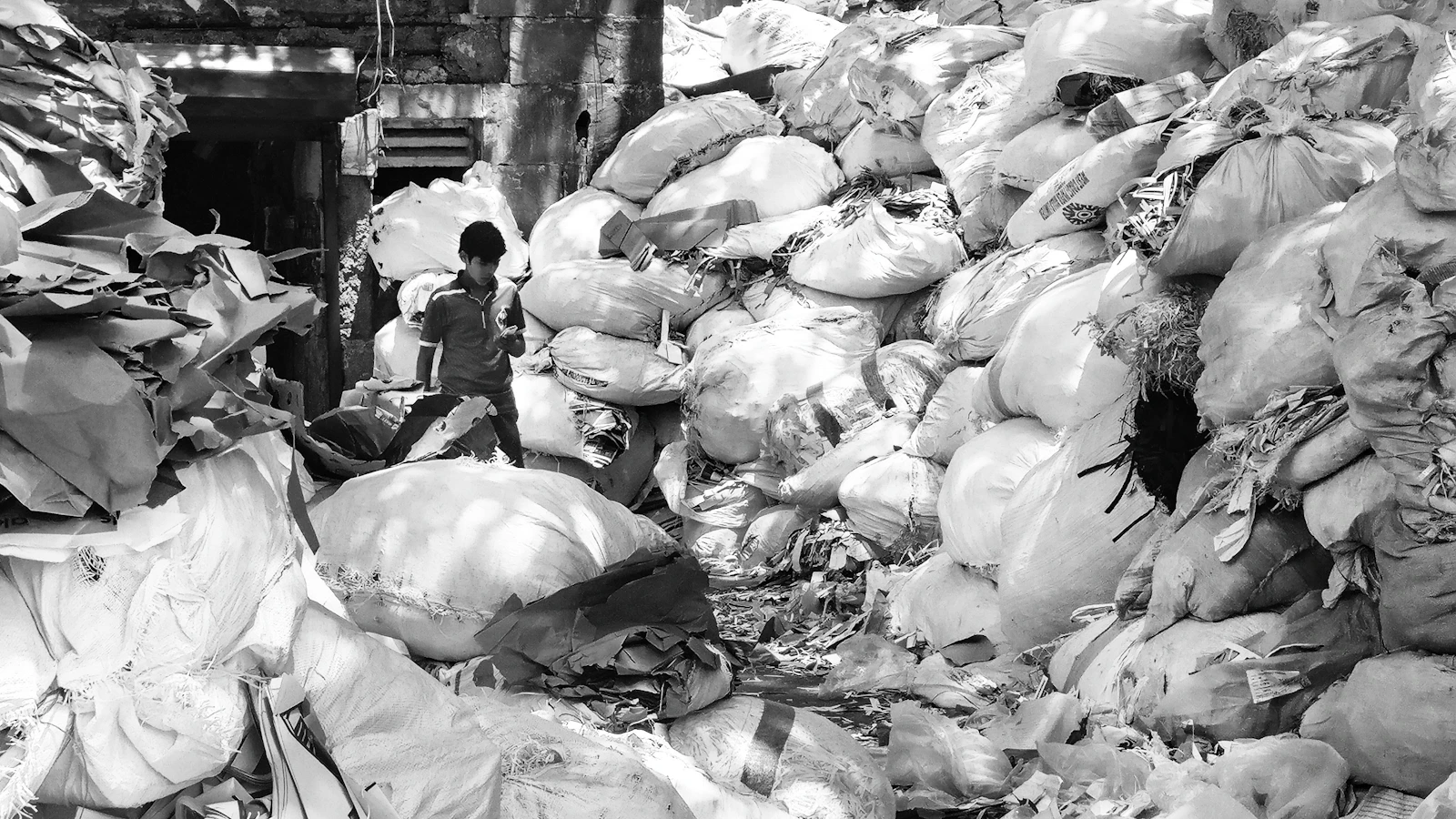
Since January 2025, every EU member state has been required to collect textiles separately from other household waste. The rule was meant to turn old clothes into a resource. Instead, it arrived as the businesses that handle them were failing: the collector and sorter Soex filed for insolvency in October 2024, Texaid did the same in June 2025, and the French collector Le Relais stopped collecting altogether in mid-2025. Industry associations had warned since spring 2024 that prices for sorted second-hand garments no longer covered the cost of processing them.
Technology is not the main bottleneck any more. Lines that combine near-infrared spectroscopy, colour cameras and machine learning can now identify a garment's fibre and colour and drop it into one of dozens of fractions at roughly one item per second. The hard part is what comes after: finding recyclers that can turn those fractions into new fibre at a competitive price, and brands willing to buy it. So the direct answer to how AI is changing textile recycling is that it is making sorting cheaper and more precise, but it cannot on its own fix an economic model in which almost nothing is recycled back into clothing.
Share of textile waste in Europe that is recycled into new textiles
Separate collection and better sorting raise the volume of material, but almost none of it yet closes the loop into new clothing.
Source: BCG analysis reported by Alchempro, 2025
Why it matters now: the revised EU Waste Framework Directive entered into force on 16 October 2025, and by 17 April 2028 every member state must run an extended producer responsibility scheme that makes brands pay for collecting, sorting and recycling the textiles they sell. The fees those schemes charge, and how they reward recyclable design, will decide whether the AI sorting plants being built today have a business.
How big is Europe's textile waste problem?
The European Environment Agency estimates that the EU generated about 6.94 million tonnes of textile waste in 2022, or roughly 16 kg per person, a level it describes as broadly stable since 2016. Only 4.6 kg per person was collected separately for reuse and recycling; the other 11.1 kg went into mixed household waste, where it is incinerated or landfilled. Around 82% of textile waste comes from consumers, the rest from manufacturing and from products that were never sold. The EEA also estimates that 4 to 9% of textile products placed on the European market are destroyed before use, between 264,000 and 594,000 tonnes a year.
The path from wardrobe to recycler narrows sharply at every stage. For 2020, the EEA's briefing set its estimate of 6.95 million tonnes generated against Eurostat figures showing 1.95 million tonnes collected and 1.41 million tonnes treated inside the EU. The agency attributes most of the gap between collected and treated volumes to exports outside the EU, mainly of used clothing to Africa and Asia.
- 6.95 million tonnes (2020Textile waste generated (EU-27)
- 1.95 million tonnes (2020Collected
- 1.41 million tonnes (2020Treated within the EU
Source: European Environment Agency (with Eurostat data), 2024
Collection performance varies enormously. The EEA puts the average capture rate at 12%, against about 50% in Luxembourg and Belgium, 37% in the Netherlands and 30% in Austria. Sorting capacity is about 1.5 million tonnes a year across the EU, with 300,000 tonnes in Poland and 200,000 tonnes in the Netherlands. Much of it still relies on trained staff picking through garments by hand to judge which are good enough to resell, which is exactly the labour-intensive step automation targets.
What changed in EU textile waste law in 2025?
Two layers of regulation now apply. The first is the separate collection obligation from 2025, which made textiles a distinct waste stream. The second is the revised Waste Framework Directive, published in the Official Journal on 26 September 2025. It requires member states to transpose its rules by 17 June 2027 and to have mandatory EPR schemes for textiles and footwear operational by 17 April 2028, with micro-enterprises following from 17 April 2029. By 2028 countries must also have nationwide collection systems that prioritise reuse and fibre-to-fibre recycling.
Under EPR, producers pay the cost of managing the waste from what they sell, including online sellers outside the EU, which must appear in national producer registers. Fees are to be eco-modulated according to environmental performance, using ecodesign requirements under the EU's Ecodesign Regulation, and member states may also adjust fees for fast and ultra-fast fashion practices such as short product lifespans. The revenue is meant to fund collection, sorting, reuse and recycling capacity, which is precisely the part of the chain that is now short of money.
The directive also sets a direction of travel for product design. By 2030, according to the text summarised by Linklaters, textiles and footwear placed on the EU market should be long-lived and recyclable, made largely from recycled fibres and free of hazardous substances. For the first time, the cost of a garment's end of life will appear on the producer's invoice, and the size of that cost will depend partly on how easily the garment can be sorted and recycled.
- Feb 2024Renewcell, the H&M-backed fibre recycler, files for bankruptcy after failing to secure funding
- Jun 2024Swedish private equity firm Altor acquires the business, later renamed Circulose
- Oct 2024German collector and sorter Soex files for insolvency
- Jan 2025Separate collection of textiles becomes mandatory across the EU
- Jun 2025Texaid files for insolvency; Le Relais stops textile collection in mid-2025
- Oct 2025Revised Waste Framework Directive with textile EPR enters into force on 16 October
- Q4 2026Circulose plans to restart production at its Sundsvall plant
- Apr 2028Textile and footwear EPR schemes must be operational in all member states
Source: Textile World 2024; FashionUnited 2026; BCG via Alchempro 2025; Linklaters 2025; EEA 2024
How does AI textile sorting work?
Automated sorting replaces the human eye with three kinds of sensor. Near-infrared spectroscopy reads the chemical signature of fibres such as cotton, polyester or wool; RGB cameras classify colour; and in some systems 3D cameras measure a garment's size and volume. Machine-learning models combine those signals and decide where each item goes, while robots or compressed-air jets move it. Precise fibre data matters because recyclers need consistent feedstock: a pulp maker such as Circulose, for example, takes discarded cotton textiles as its raw material.
The Spanish company Picvisa's installation at Essaimons in Châtellerault, France, shows what current systems claim. Its Ecosort Textile line uses near-infrared and RGB cameras with machine-learning algorithms and a spectral library covering 11 fibre types and their blends. It processes roughly one garment per second, or 1 to 1.2 tonnes per hour, from bales of up to 500 kg, and the client specified a maximum classification error of 10% across more than 25 target fractions and nine colour categories. The measured accuracy has not been published.
Belgium's Valvan took a robotic approach with Fibersort. According to Siemens, which supplied its motion control, each garment is scanned by a 3D camera, a colour camera and an infrared camera, and AI makes the sorting decision. Picking cycles fell from 10 to 15 seconds with an early gantry picker to 1.8 seconds, giving about 2,000 garments per hour. "With the help of AI, we succeeded in this," said Valvan's chief technology officer, Maurits Vandeputte. The pioneer of fully automated sorting, the SIPTex plant built by Stadler with four TOMRA near-infrared units for Sysav in Malmö, was handed over in 2020 and handles up to 4.5 tonnes per hour on one line. "The plant is fully automated: people are needed only to start and stop the plant," said Urban Kozinc, international sales manager at Stadler. Its earlier pilot in Avesta had processed 700 tonnes of used textiles, a reminder of how small the first steps were.
New entrants are focusing on the data layer. Refiberd, based in California, uses hyperspectral imaging and AI to determine textile composition and won the Global Fashion Agenda's 2025 Trailblazer programme, with an investment of up to USD 200,000 from PDS Ventures. In the UK, Circle-8 Textile Ecosystems bought an AI-driven sorting line from Denmark's NewRetex as part of a planned 25,000-tonne-a-year sorting and pre-processing plant, part-funded by the Innovate UK project ACT UK. Its software records the weight and fibre composition of each piece, a step towards traceable feedstock and digital product passports.
| System | Sensing and AI | Reported throughput | Status |
|---|---|---|---|
| Picvisa Ecosort, Essaimons (France) | NIR, RGB cameras, machine learning, 11 fibre types | About 1 garment per second, 1 to 1.2 t/h | Operational |
| Valvan Fibersort (Belgium) | 3D, colour and infrared cameras, AI decision | About 2,000 garments per hour | Commercial machine |
| Stadler and TOMRA for Sysav (Sweden) | Four NIR sorting units | Up to 4.5 t/h on one line | Handed over 2020 |
| NewRetex line for Circle-8 (UK) | Fibre, colour and hardware sorting | Plant designed for 25,000 t/year | Purchased 2025 |
| Refiberd (US) | Hyperspectral imaging and AI | Not disclosed | Award winner 2025 |
Why is Europe's textile collection and sorting industry in crisis?
The business model of collectors depends on reselling the best garments as second-hand, much of it outside the EU, to pay for handling the rest. That model has broken down. In October 2024 the recycling federation EuRIC and Municipal Waste Europe warned that second-hand textile prices had fallen significantly while collection, sorting and recycling costs had risen rapidly, blaming the war in Ukraine, logistics problems in Africa, an oversupply of used textiles and the rise of ultra-fast fashion, whose garments are worth little on resale. EU trade in used textiles with non-EU countries fell from 464,993 tonnes in 2022 to 430,185 tonnes in 2023.
A BCG analysis reported in September 2025 described a breakdown in the collection and sorting system: eco-organisations and public authorities pay too little per tonne to cover operating costs, while landfill still took 26% of total textile waste in 2024. The insolvencies of Textile Recycling International in early 2024, Soex and Texaid followed. Separate collection, by increasing the volume of low-value material entering the system without funding to process it, has so far deepened the problem rather than solved it.
This is where AI sorting promises the most. If machines can sort non-reusable textiles cheaply and precisely by fibre, the large share of collected clothing that cannot be resold becomes saleable feedstock for recyclers instead of a disposal cost. But that only works if recyclers exist to buy it.
What went wrong at Renewcell, and can Circulose succeed?
Renewcell was the flagship of fibre-to-fibre recycling: a Swedish company turning discarded cotton into Circulose, a dissolving pulp for viscose and lyocell, with H&M among its largest shareholders. On 25 February 2024 its board decided to file for bankruptcy after failing to raise the funding to complete a strategic review. Chairman Michael Berg said the failure was "a testament to the lack of leadership and necessary pace of change in the fashion industry". Tricia Carey, its chief commercial officer, told Fashion Dive that brands had shown strong interest during the pilot phase, but at commercial scale "there was not that same level of interest", and some buyers said "the price of Circulose is too high".
The bankruptcy also exposed how many parties had carried the risk. Renewcell had negotiated with its two largest shareholders, H&M and Girindus, and with lenders including BNP Paribas, the European Investment Bank, Nordea, AB Svensk Exportkredit and Finnvera as partial guarantor, without reaching a deal. When it collapsed, about 4,000 tons of fibre and more than 12,000 tons of pulp remained in inventory. Carey argued that comparing a new material with generic fibres was unfair: "How do you compare a brand new material to a fiber that's been around for 100 years."
Altor, a Swedish private equity firm, bought the business in June 2024. Circulose, as it is now called, is led by Jonatan Janmark, a former McKinsey partner, and chaired by Helena Helmersson, former chief executive of H&M Group. It has commitments from 11 global fashion brands, including Bestseller, John Lewis, C&A and Reformation, which signed in December 2025, alongside H&M Group, Mango and Marks & Spencer, plus cooperation agreements with fibre producers Tangshan Sanyou, Aditya Birla and Jilin Chemicals. It plans to restart the Ortviken plant in Sundsvall in the fourth quarter of 2026 with a target capacity of 60,000 tonnes a year. "Our plan was to align the production restart with confirmed demand," Janmark said. Committed offtake, not technology, was the lesson.
What are the limits and risks of AI sorting?
First, accuracy figures are scarce. None of the plants described here publishes independently measured sorting purity; Essaimons reports a contractual error ceiling of 10%, not a measured result. Hardware such as buttons and zips must be detected or removed, which is why Valvan also sells Trimclean, a machine that strips buttons and labels, and why Circle-8 sorts by hardware as well as fibre and colour. Garments weighing anywhere from about 20 g to nearly 2 kg pass along the same line, and blends multiply the categories a model must learn.
Second, capacity downstream is thin. The EEA counted 17 textile recyclers expected to process 1.25 to 1.3 million tonnes of fibres a year by 2025, about 1 million tonnes mechanically and 250,000 tonnes chemically, and noted that most recycled fibres are downcycled into products such as rags or insulation. In the UK, recycling turns under 1% of more than 700,000 tonnes of non-reusable textiles a year into new textile materials.
Third, EPR itself carries risk. Fees set too low will not close the funding gap; fees that ignore design will not reward recyclable products. Eco-modulation depends on ecodesign criteria still being developed, and national schemes may diverge, adding compliance cost for brands selling across Europe. Finally, exports remain a safety valve that EPR money does not follow: the EEA notes that sending used textiles to Africa and Asia deprives receiving countries of financial support for handling the waste.
What should fashion companies do now?
- Prepare for EPR fees Build a product-level register of volumes, materials and weights per EU market so fees can be calculated before schemes go live by April 2028.
- Design for sortability Favour mono-materials, avoid blends that sensors misread, and make trims easy to remove so garments can enter recycling fractions.
- Publish accurate fibre data Ensure composition labels and digital records are correct, because AI sorters and recyclers depend on reliable material information.
- Commit to recycled fibre offtake Sign binding volume agreements with fibre-to-fibre recyclers rather than letters of interest, accepting a price premium during scale-up.
- Engage with sorters directly Partner with automated sorting plants on feedstock specifications so collected garments match what recyclers need.
- Track national scheme rules Monitor how each member state sets eco-modulation and fast fashion criteria, and adjust product decisions to avoid the highest fees.
Frequently asked questions
How much textile waste does the EU produce?
The European Environment Agency estimates the EU generated about 6.94 million tonnes of textile waste in 2022, roughly 16 kg per person. Only 4.6 kg per person was collected separately for reuse and recycling; the remaining 11.1 kg ended up in mixed household waste.
When does textile EPR start in the EU?
The revised Waste Framework Directive entered into force on 16 October 2025. Member states must transpose it by 17 June 2027, and extended producer responsibility schemes for textiles and footwear must be operational by 17 April 2028, with micro-enterprises covered from 17 April 2029. Fees will be eco-modulated, and countries may also modulate them for fast and ultra-fast fashion practices.
How does AI textile sorting work?
Automated lines combine near-infrared spectroscopy to identify fibres, colour cameras and sometimes 3D cameras, with machine-learning software deciding which fraction each garment goes into. The Picvisa line at Essaimons in France handles roughly one garment per second and identifies 11 fibre types and blends, and Valvan's Fibersort reaches about 2,000 garments per hour.
Why did Renewcell go bankrupt?
Renewcell filed for bankruptcy in February 2024 after failing to raise funding during a strategic review. Its commercial officer said offtake agreements did not come through and some buyers considered Circulose too expensive. Altor bought the business in June 2024, and the renamed Circulose plans to restart production in Sundsvall in the fourth quarter of 2026.
Sources
- European Environment Agency: Textile waste generation per person in the EU per year
- European Environment Agency: Management of used and waste textiles in Europe's circular economy
- Linklaters: EU revised Waste Framework Directive to cater for food and textile waste published
- Fashion Dive: Renewcell bankruptcy, what's next
- Alchempro: Europe's textile waste management system under critical strain, BCG
- Letsrecycle: EuRIC, used textiles industry on brink of collapse
- Recycling Inside: AI-powered sorting transforms post-consumer textile recycling in France
- Siemens: Valvan Fibersort
- TOMRA: TOMRA and STADLER deliver world's first automated textile sorting plant
- UKFT: Circle-8 secures its first standalone, AI-driven, automated textiles sorting line
- Textile World: Re:NewCell decides to file for bankruptcy
- FashionUnited: Circulose reopens Sundsvall factory following strategic restructuring