Hidden Champion: Karl Mayer, the machinery behind the world's knits
This German family firm supplies the warp knitting machines that make everything from sportswear to lingerie, automotive interiors to mosquito nets.

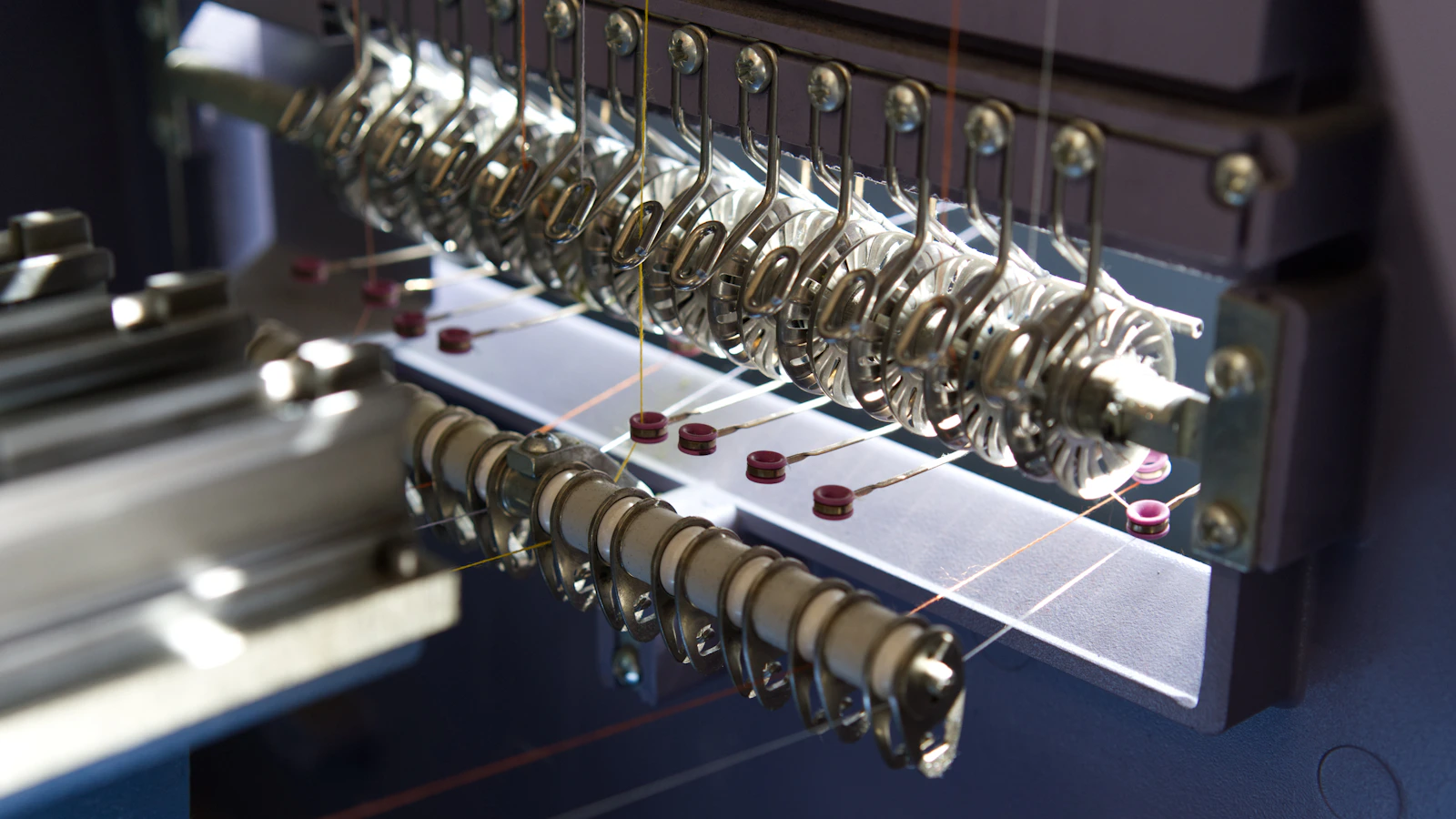
KEY TAKEAWAYS Summary by the editors
- Karl Mayer is the world's leading manufacturer of warp knitting machines, used to produce fabrics for activewear, lingerie, automotive interiors and technical textiles.
- The family-owned company, founded in 1937, has around 2,400 employees worldwide and 18 locations across Germany, China, the USA, India, Italy, Japan and other markets.
- The firm acquired flat knitting specialist Stoll in 2020 but divested it in 2025 to refocus on its core warp knitting, technical textiles and warp preparation businesses.
- Karl Mayer is investing in digital production management software, cloud-based patterning and AI-era opportunities in glass fabric for printed circuit boards.
Every time a consumer pulls on seamless activewear, slips into stretchy lingerie or slides into a car with a knitted seat cover, there is a good chance the fabric started its life on a machine made by Karl Mayer. The German manufacturer builds the warp knitting equipment that textile mills worldwide use to produce these materials at industrial scale.
Yet Karl Mayer is the world's leading manufacturer of warp knitting machines, a position built on nearly nine decades of focus on a technology most fashion executives have never heard of. The most surprising fact: around four billion metres of glass fabric are produced worldwide each year, with another two billion metres expected by 2028, much of it for AI data centre circuit boards, made on Karl Mayer warp preparation machines.
What does Karl Mayer make and who uses it?
The Obertshausen, Germany company manufactures tricot warp knitting machines, raschel knitting machines and a range of warping machines for both knitting and weaving preparation. For the production of technical textiles Karl Mayer produces warp knitting machines with parallel weft insertion for the production of high-strength textile structures and grids and Multiaxial and biaxial machines for fibreglass and carbon composites and stitch-bonding machines for the production of mechanically-reinforced nonwovens and composites.
Inside the TIC showroom, textile concepts and materials are grouped by end-use applications, including fashion and apparel, sports textiles, footwear, home textiles and technical textiles. These are used to produce materials for sportswear, fine lingerie, curtains, shoes, ship hulls, and even baby diapers.
Customer brands named in sources include Decathlon, Lululemon, Banana Republic, Under Armour, Hugo Boss and Victoria's Secret, which buy fabrics from mills using Karl Mayer machines. Technosport, an Indian activewear brand, has formed a strategic partnership with textile machinery manufacturer Karl Mayer to utilise advanced Tricot machines for the production of active and sportswear, marking Technosport as Karl Mayer's inaugural customer in South India to implement these machines for active and sportswear manufacturing.
How big is Karl Mayer?
He founded the company in 1937, which developed into an intenational market leader in its sector. Our history is characterised by visionary strength, entrepreneurial courage and a drive to innovation. Years Family business: 89. Locations worldwide: 18. Employees worldiwde: 2400. The company remains family owned, with Karl J. Mayer serving as representative of the advisory board and the Mayer family.
Karl Mayer itself is a family-owned business founded in 1937 in Obertshausen and currently has more than 2,800 employees worldwide. Employee counts vary by source and timing; KARL MAYER Textilmaschinen GmbH has approximately 756 total employees worldwide as of March 2026, according to Revelio Labs workforce intelligence data. Karl Mayer's total headcount has declined 26.4% from 1,028 employees in 2023 to 756 in 2026, reflecting restructuring after the Stoll divestment.
Source: Karl Mayer website, 2026
Revenue figures are estimated rather than publicly disclosed. KARL MAYER's revenue is $627.8 Million according to ZoomInfo, though As of August 2026, KARL MAYER's annual revenue is estimated to be $250M - $500M per LeadIQ. With more than 2800 employees worldwide, the international organization produces in its main markets, so that KARL MAYER is always close to its customers and their needs. Today, the company has subsidiaries in the USA, India, Italy, Hong Kong, Japan, China, Bangladesh and Switzerland as well as agencies all over the world.
Why does Karl Mayer lead its niche?
Some of the major players in europe textile machinery market include Rieter AG, KARL MAYER Group, Picanol NV, Trützschler Group SE, Itema Group, which collectively held 48% market share in 2025. Leading Players: Top 5 players in this market include Rieter AG, KARL MAYER Group, Picanol NV, Trützschler Group SE, Itema Group, which collectively held a market share of 48% in 2025. In India, according to Navin Agrawal, KARL MAYER has installed around 1,500 machines over the last 15 years and now holds a 60 to 70% market share - with an upward tendency.
Karl Mayer is a German family-run technology and market leader, as well as driving force for innovations in textile machinery building. The manufacturer offers solutions for warp knitting, technical textiles and warp preparation for weaving. The company's strength lies in deep technical expertise: Starting in the 1960s the KARL MAYER Academy Germany has been supporting customers from around the globe for a long time. Highly competent trainers with many years of experience assist you and your team in improving your know-how in machine-handling, maintenance and textile analyses. Years of training experience: 65. Learners per year: 200. Nationalities: 44.
Karl Mayer is now the leading provider of solutions for the two most important stitch-forming processes, flat knitting, and warp knitting, though the firm later divested flat knitting. In early 2025, Karl Mayer announced a strategic decision to focus on its core business areas of warp knitting, warp preparation and technical textiles. As part of the move, the flat knitting machine business under the Stoll brand was discontinued and the production site in Reutlingen, Germany, was closed in October 2025. The assets - including among other things the Stoll brand, selected materials and stock and specific technological assets - are now to be transferred to Ningbo Cixing (Cixing Group), with the closing of the transaction still pending.
- 1937Karl Mayer founded the company in Obertshausen, Germany
- 1960sKarl Mayer Academy established to train customers worldwide
- 2016Acquired Santoni's warp knitting technology for Nippon Mayer subsidiary
- 2020Acquired Stoll flat knitting machine manufacturer
- April 2026Opened Textile Innovation Center in Obertshausen
- October 2025Closed Stoll Reutlingen site, sold assets to Cixing Group
Source: Karl Mayer announcements, trade press
How does Karl Mayer use digital technology and automation?
Called Digital Production Management software by KM.ON, the new offering targets shop-floor control, an area of the supply chain increasingly ripe for an innovative makeover. Karl Mayer developed the Digital Production Management software through KM.ON, the business division leveraging an agile strategy to birth digital enterprise solutions. It merges Internet of Things, or IoT, technology along with cutting-edge analytics to crank out insight-rich reports that leaders can use to streamline their production.
To maximise productivity, the Karl Mayer Group is specifically developing smart machine functions that exploit the potential of digitalisation or artificial intelligence, for example, to revolutionise pattern change in warp knitting through cloud-based patterning. High-performance tricot machines of the digital generation such as the HKS 3-M ON work with pattern data from the cloud instead of pattern discs and, thus, offer unique flexibility. Patterns can be changed at the click of a mouse on the computer and without manual intervention.
A dashboard for monitoring with real-time data on machine operation is also provided for KARL MAYER's warp preparation machines, especially for the sectional warping sector, and STOLL PPS is a digital production planning tool for the flat knitting mill (the latter before the Stoll divestment). Smart Machine comprises special functions that are backed by KARL MAYER's expertise and enable customers to maximize their productivity. The required lapping data is acquired with just a few clicks in KARL MAYER's WEBSHOP SPARE PARTS and loaded directly from the KM.ON cloud.
What unexpected growth opportunities has Karl Mayer found?
The company has found a surprising growth engine in artificial intelligence infrastructure. For KARL MAYER's Warp Preparation Business Unit, the enormous demand for CCLs made from glass fabric means an excellent order income level. Currently, around four billion meters of glass fabric are produced worldwide each year. By 2028, another two billion meters will be added - a massive market in which we lead with a major market share, says Enzo Paoli, president of the Warp Preparation Business Unit.
AI data centers require increasingly complex printed circuit boards, with copper-clad laminate exceeding 24 layers, compared with six layers for standard electronics. KARL MAYER said precise yarn-tension control during warp preparation helps prevent fabric-density variation that can affect high-frequency signal transmission. The company said it has supplied leading glass-fabric manufacturers for nearly 20 years, reaching a milestone of 100 electronic-glass machines sold in China in 2020.
What risks and competition does Karl Mayer face?
The Stoll acquisition and subsequent divestment highlight strategic risks. As part of its growth strategy, the KARL MAYER Group has concluded an agreement to acquire the STOLL Group. The contract was signed on February 26, 2020, and the Stoll Group is to be part of the Karl Mayer Group from July 1, 2020. However, five years later the company reversed course, closing the Reutlingen flat knitting operation.
The workforce contraction reflects restructuring pressures. Karl Mayer's total headcount has declined 26.4% from 1,028 employees in 2023 to 756 in 2026, though company sources cite higher global employee numbers including subsidiaries. Competition comes from different machinery segments: Santoni is a leader in the textile machinery sector, specializing in the production of circular electronic knitting machines for seamless clothing. Santoni primarily serves the textile manufacturing industry, providing innovative solutions to meet the evolving demands of the fashion market, while Shima Seiki dominates flat knitting.
Chinese competition is intensifying. If confirmed, a Cixing acquisition would represent a significant moment for the flat knitting sector. Cixing already holds a dominant global position, and the addition of Stoll - a brand long associated with premium German engineering and advanced flat knitting technology - could further consolidate its market leadership. However, in warp knitting Karl Mayer maintains its lead through technical expertise and customer training infrastructure built over decades.
What can fashion companies learn from Karl Mayer?
First, niche leadership beats diversification. Karl Mayer's decision to exit flat knitting and refocus on warp knitting, technical textiles and warp preparation demonstrates that defending market leadership in a specialised field can be more valuable than expanding into adjacent categories, even when acquisition seems strategically logical.
Second, invest in customer capability, not just product. years of training experience: 65. Learners per year: 200. Nationalities: 44 shows Karl Mayer has spent six decades teaching customers how to maximise their machines. This creates switching costs and loyalty far beyond product features.
Third, look beyond obvious applications. At JEC World 2026, Karl Mayer highlighted work tied to composite materials for automotive, drone and lightweight construction applications. The company also used recent trade events to showcase warp-knit developments in sports textiles, UV-protective fabrics and technical netting. While competitors chase fashion trends, Karl Mayer builds positions in mosquito nets, circuit board substrates and automotive composites where technical performance, not style, drives demand.
Fourth, proximity to production matters. With more than 2800 employees worldwide, the international organization produces in its main markets, so that KARL MAYER is always close to its customers and their needs. For capital equipment requiring installation, training and ongoing service, local presence remains essential even in a digital age.
Frequently asked questions
What is warp knitting and why does it matter for fashion?
Warp knitting is a textile production method where yarns run lengthwise and interlock to create fabric. It produces materials for activewear, lingerie, automotive upholstery, technical textiles and medical applications. Unlike weft knitting (used for sweaters), warp knitting creates stable, run-resistant fabrics at high speeds, making it essential for industrial-scale production of performance textiles.
Why did Karl Mayer sell Stoll after acquiring it in 2020?
Karl Mayer acquired Stoll in 2020 to expand into flat knitting machinery but divested it in 2025 to refocus on its core businesses of warp knitting, technical textiles and warp preparation. The Reutlingen flat knitting site closed in October 2025, with assets sold to Chinese manufacturer Cixing Group, as Karl Mayer chose to prioritise its market-leading warp knitting position rather than compete in the separate flat knitting segment.
How is Karl Mayer connected to the AI boom?
Karl Mayer supplies warp preparation machinery used to manufacture glass fabric, which becomes the base material for copper-clad laminates in printed circuit boards. AI data centres require increasingly complex circuit boards with over 24 layers, driving demand for high-quality glass fabric. The company estimates annual production of around four billion metres of glass fabric globally, with another two billion metres of capacity expected by 2028.
Sources
- Knitting Industry: Karl Mayer world's leading warp knitting manufacturer
- Textile World: Karl Mayer acquires Stoll (2020)
- Knitting Industry: Cixing Group acquires Stoll assets from Karl Mayer
- Fibre2Fashion: Ekoten Textile invests in Karl Mayer tricot machines
- WWD: Karl Mayer launches Digital Production Management software
- Textile World: Karl Mayer supplies warp preparation technology behind AI boom
- Karl Mayer: About us (company website)
- WWD: Karl Mayer's Textile Innovation Center