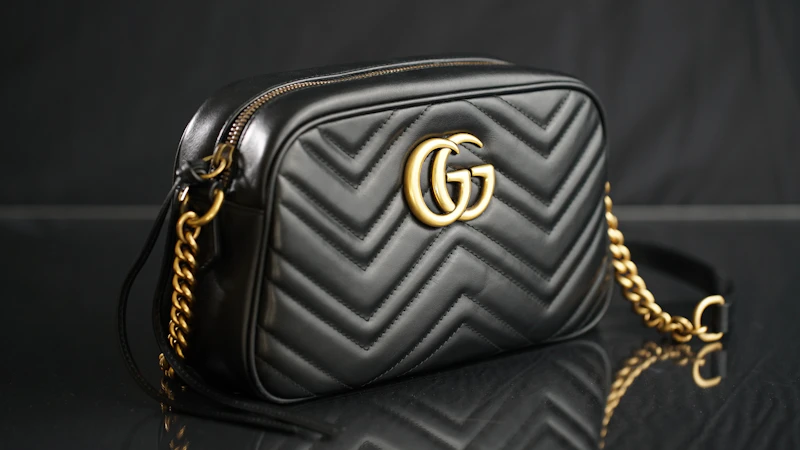
Gucci
Kering · Italy
Gucci is the Florentine luxury house founded by Guccio Gucci in 1921 and the largest brand of the Paris-listed group Kering, which has controlled it since 1999. Known for the Bamboo bag, the loafer and the double-G logo, it is being rebuilt under artistic director Demna and chief executive Francesca Bellettini.
Sources: Wikipedia: Gucci; Kering: 2025 results press release
| Founded | 1921, Florence, Italy3 |
|---|---|
| Founder | Guccio Gucci3 |
| Headquarters | Florence, Italy3 |
| Owner | Kering Paris-listed group controlled by the Pinault family; Gucci has been a Kering subsidiary since 199931 |
| Revenue | EUR 5.99 bn (2025, Gucci house revenue, all channels)1 |
| Employees | about 20,000 (2024, Gucci)3 |
| Website | gucci.com |
What is Gucci?
Gucci designs and sells leather goods, shoes, ready-to-wear, jewellery, watches and eyewear, with headquarters on Via Tornabuoni in Florence. It is the biggest house of Kering, whose chief executive Luca de Meo, in office since September 2025, calls Gucci's recovery the group's defining priority. Demna, artistic director of Balenciaga since 2015, was appointed artistic director of Gucci in March 2025 with effect from July 2025, and Francesca Bellettini, previously Kering's deputy CEO, became president and CEO in September 2025, replacing Stefano Cantino.
Gucci's revenue fell 22% as reported and 19% on a comparable basis to EUR 5.99 billion in 2025, from EUR 7.65 billion in 2024, and recurring operating income dropped 40% to EUR 966 million, a margin of 16.1%. Directly operated retail generated 92% of 2025 revenue. The decline slowed through 2026: nine-month revenue to September 2026 was EUR 4.05 billion, down 5% comparable, and the third quarter was down 6% comparable at EUR 1.29 billion.
History
Guccio Gucci founded the business in Florence in 1921 and added handbags in 1937. The Bamboo bag (1947), the loafer (1952) and the Jackie bag (1961) became lasting codes, and the double-G logo followed in 1964. Under the second generation the house opened in Rome (1938), New York (1953), London and Palm Beach (1961), Paris (1963) and on Rodeo Drive (1968).
After Maurizio Gucci took over in 1983, family disputes weakened the company; Investcorp bought almost 47.8% in 1988 and the rest in 1993. Tom Ford and Domenico De Sole revived the brand from 1994, and Gucci listed on the New York Stock Exchange in October 1995 at USD 22 per share. Pinault's group, now Kering, bought into Gucci in 1999 and made it a subsidiary; Ford and De Sole left in 2004. Frida Giannini (2006 to 2015), Alessandro Michele (2015 to 2022) and Sabato De Sarno (2023 to early 2025) followed as creative directors, before Demna moved over from Balenciaga in 2025.
- 1921Guccio Gucci opens a leather goods shop on Via della Vigna Nuova in Florence.
- 1937Gucci launches handbags; a Rome store on Via Condotti follows in 1938.
- 1947The Bamboo bag is introduced, followed by the Gucci loafer in 1952.
- 1953First US store opens on Fifth Avenue in New York.
- 1964The double-G logo is introduced on belt buckles and accessories.
- 1993Investcorp completes its takeover, ending family involvement.
- 1994Tom Ford becomes creative director and Domenico De Sole chief executive.
- 1999Pinault's group, later Kering, takes control of Gucci.
- 2015Alessandro Michele becomes creative director, a role he holds until 2022.
- 2023Sabato De Sarno becomes creative director; Gucci ends the collaboration in February 2025.
- 2025Demna named artistic director in March; Francesca Bellettini becomes president and CEO in September.
- 2026Demna's first runway show in Milan in February; L'Oréal beauty licence agreed in July.
Products and price range
Leather goods and shoes lead Gucci's business, supported by ready-to-wear, jewellery, watches and eyewear. Signature products include the Bamboo bag, the Jackie bag, the loafer and pieces marked with the double-G logo. Under the 2026 action plan Gucci is refining its product and pricing architecture and improving quality and time to market, with a focus on handbags, ready-to-wear and shoes; the La Famiglia collection, presented in September 2025 and rolled out from January 2026, marked Demna's first range.
Beauty is licensed. On 7 July 2026 Gucci agreed a 50-year exclusive beauty licence with L'Oréal, expected to take effect in mid-2027, subject to approvals and the early termination of the existing agreement with Coty.
| Line | What |
|---|---|
| Handbags and leather goods | Bamboo, Jackie and logo bags, small leather goods |
| Shoes | loafers, sneakers and women's footwear |
| Ready-to-wear | women's and men's collections designed by Demna |
| Jewellery and watches | fine and fashion jewellery, timepieces |
| Beauty | fragrance and make-up under licence, moving from Coty to L'Oréal from mid-2027 |
Distribution and retail
Gucci sells mainly through directly operated stores and its own e-commerce, which together generated 92% of revenue in 2025. Kering closed 105 stores net across its houses in the first nine months of 2026 and plans at least 125 closures for the full year. North America was Gucci's most resilient region in the third quarter of 2026, while Asia Pacific, in particular mainland China, and Japan were weaker on lower traffic.
Wholesale accounted for about 9% of Gucci's third-quarter 2026 sales, at EUR 120 million. In October 2025 the European Commission fined Gucci EUR 119.7 million over past commercial practices; the fine was settled in 2025.
- Own stores: directly operated stores generate 92% of revenue (2025)
- E-commerce: own online store at gucci.com
Wholesale and B2B
Gucci is predominantly a retail-led brand. In 2025 its revenue fell 22% as reported (19% comparable) to EUR 5,992 million, with directly operated stores and e-commerce generating 92% of sales and down 18% comparable, while wholesale revenue dropped 34%. In the fourth quarter wholesale fell 14% against a 10% decline in own retail. At group level Kering wholesale fell 9% comparable in 2025, which the group attributes to its houses deliberately sharpening the exclusivity of their distribution.
The reduction of wholesale is a long-running policy: in 2018 Gucci had closed 25% of its wholesale relationships and set a target of bringing wholesale below 10% of sales. Gucci is also concentrating its outlet presence on a small number of exclusive venues.
Management
- Francesca Bellettini, President and Chief Executive Officer (since 2025)
- Demna, Artistic Director (since 2025)
- Luca de Meo, Chief Executive Officer, Kering (since 2025)
Latest developments 2025/26
- Gucci's third-quarter revenue fell 6% comparable to EUR 1.29bn; nine-month revenue was EUR 4.05bn, down 5% comparable.2
- Gucci agreed a 50-year exclusive beauty licence with L'Oréal, expected to take effect in mid-2027.26
- Kering CEO Luca de Meo confirmed Gucci-branded AI smart glasses with Google, running on Android XR and expected in 2027.5
- Demna presented his first Gucci runway show in Milan, with a teaser film directed by Spike Jonze and Halina Reijn.4
- Kering reported Gucci 2025 revenue of EUR 5.99bn, down 19% comparable, and recurring operating income of EUR 966m.1
AI and digital
During the week of Demna's Milan runway debut in February 2026, Gucci posted AI-generated images of models wearing its accessories on Instagram and later labelled them as AI-generated; Demna described AI as a tool for quick visualisation. In April 2026 Kering CEO Luca de Meo confirmed that Gucci is developing Gucci-branded smart glasses with Google that run Gemini AI on the Android XR platform, with a launch expected in 2027.
Gucci compared with similar brands
| Gucci | Prada | Saint Laurent | Bottega Veneta | |
|---|---|---|---|---|
| Founded | 1921 | 1913 | 1961 | 1966 |
| Headquarters | Florence, Italy | Milan, Italy | Paris, France | Milan, Italy |
| Owner | Kering | Prada S.p.A. (Prada Group) | Kering | Kering |
| Price level | Luxury | Luxury | Luxury | Luxury |
| Segment | Luxury and designer houses | Luxury and designer houses | Luxury and designer houses | Luxury and designer houses |
| Revenue | EUR 5.99 bn (2025) | EUR 5.718 bn (2025) | EUR 2,643 m (2025) | EUR 1.71 bn (2025) |
| Channels | Own stores, E-commerce, Department stores, Licensing | Own stores, Wholesale, E-commerce, Licensing | Own stores, E-commerce, Department stores, Licensing | Own stores, E-commerce, Department stores |
Frequently asked questions
Who owns Gucci?
Gucci is owned by Kering, the Paris-listed luxury group controlled by the Pinault family. It has been a Kering subsidiary since 1999, when the group was still called PPR.
Who is Gucci's creative director?
Demna was appointed artistic director in March 2025, effective July 2025, and showed his first runway collection in Milan in February 2026. He had led Balenciaga as artistic director since 2015.
Who is the CEO of Gucci?
Francesca Bellettini has been president and CEO of Gucci since September 2025, reporting to Kering CEO Luca de Meo. She was previously deputy CEO of Kering.
How much revenue does Gucci make?
Gucci generated EUR 5.99 billion in 2025, down 19% on a comparable basis from EUR 7.65 billion in 2024. Nine-month revenue to September 2026 was EUR 4.05 billion, down 5% comparable.
Where is Gucci from?
Gucci was founded in Florence by Guccio Gucci in 1921 and is still headquartered there on Via Tornabuoni. Its first US store opened in New York in 1953.
Who makes Gucci perfume?
Gucci fragrances are produced under licence by Coty. Under an agreement of July 2026, the licence is due to move to L'Oréal for 50 years from mid-2027.
As of: 5 November 2026
People
SOURCES
- Kering: 2025 results press release
- Kering: Revenue for the third quarter of 2026
- Wikipedia: Gucci
- CNN Style: Gucci asks, can AI ever be luxury?
- Hypebeast: Google x Gucci AI smart glasses could arrive in 2027
- Modaes: L'Oréal to Steer Gucci Beauty as Kering Shifts Licensing Rights
- Milano Finanza: Francesca Bellettini is Gucci's new CEO
- Glossy: How Gucci plans to cut wholesale revenue to less than 10 percent of its business